

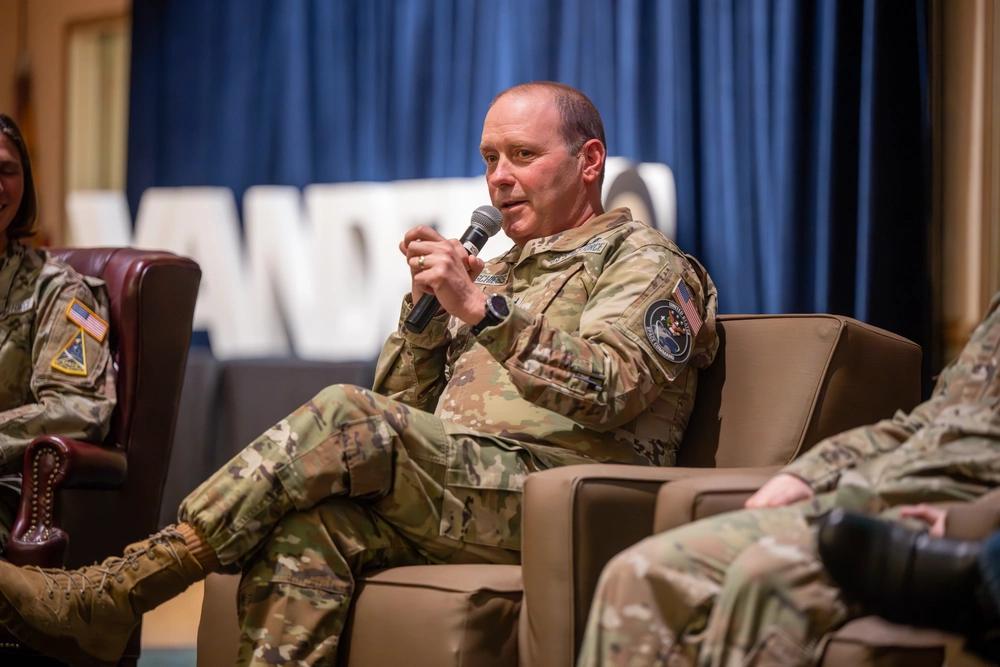
The ability to fight and maintain superiority in the space domain is becoming increasingly essential to deterrence on Earth as adversaries continue to target space as a first in conflicts globally, say lawmakers and Lt. Gen. Douglas A. Schiess, the U.S. Space Force chief candidate.
Military conflicts, especially the war in Iran, have “tested” the Space Force substantially for the past five months, Senate Armed Services Committee Ranking Member Sen. Jack Reed, D-RI, said Thursday in a hearing to discuss the nomination of Lt. Gen. Schiess to be the third-ever chief of space operations for the Space Force.
“Space Force assets were among the first to be deployed in Operation Epic Fury and among the first to be targeted,” Reed said in the hearing. “Iran has specifically targeted Space Force command and control nodes and weapon systems throughout this conflict.”
In an Air Force statement announcing Schiess’ nomination, it said that operations such as Iran and Venezuela have “underscored guardians’ ability to deliver combat-ready, asymmetric advantages from space.”
Iran has claimed to have the ability to effectively use the space domain for satellite intelligence and reconnaissance and space launch vehicles with assistance from partners, such as Russia, which could interfere with U.S. or allied assets.
Reed said that Space Force officials before Schiess spent the past seven years since its creation building the organization from scratch through focusing on issues like personnel, infrastructure and base operations.
“That was appropriate for a new service finding its footing, but the Space Force is quickly becoming a mature warfighting entity,” Reed said.
Schiess argued that American space capabilities are crucial to deterring adversaries, like China and Russia, as the countries continue to boost their own capabilities in an effort to exploit space for intelligence, surveillance and reconnaissance purposes as well as fielding systems that can threaten the U.S. link to American forces.
“The United States no longer has the luxury of viewing space as a permissive environment,” Chairman Sen. Roger Wicker, R-Miss., said in the hearing. “China and Russia have made clear that they see space as a critical warfighting domain.”
In particular, Schiess said that China’s anti-satellite tests and electronic jamming capabilities are “worrisome” as they use their efforts to target American forces farther than in the past.
“[China] built a kill chain to be able to see our carrier strike groups, our bombers, at much farther pace, speed and distances, and they’ve also developed missiles and weapon systems to go after that,” Schiess said. “So the Space Force needs to be able to bring capability to deny, degrade that kill web to be able to protect the joint force.”
When asked if the fight of the next major conflict would be in space, Schiess said it’s a possibility. He said that if not, space would be at the very forefront of a conflict, especially with China and Russia.
“I think about China every day,” Schiess said.
Schiess was first nominated by President Donald Trump to be the force’s highest-ranking officer in May. If confirmed, he would take over the role from Gen. Chance Saltzman, who is scheduled to retire this year after serving in the role for four years.
Cristina Stassis is a reporter covering stories surrounding the defense industry, national security, military/veteran affairs and more. She previously worked as an editorial fellow for Defense News in 2024 where she assisted the newsroom in breaking news across Sightline Media Group.
Read the full article here