

The Navy and the Defense POW/MIA Accounting Agency (DPAA) have dropped their initial opposition to disinterring the graves of battleship Arizona crew members buried more than 80 years ago as unknowns for possible identification and return to their families.
In a late Thursday release, DPAA announced that the Operation 85 advocacy group led by family member Kevin Kline had met the 60% threshold of DNA Family Reference Samples for the number of crew members thought to be buried in the commingled graves at the National Memorial Cemetery of the Pacific, known as the “Punchbowl.”
Although DPAA initially opposed the USS Arizona (BB-39) Unknown Identification Project, DPAA extended “its sincere appreciation” to Kline, grandnephew of Arizona crew member Gunner’s Mate 2nd Class Robert Edwin Kline, “and the ‘Operation 85’ team for their devoted efforts over the past three years to locate and connect enough USS Arizona families to help reach this important milestone.”
Last November, Operation 85 announced that they had reached the required 60% threshold for the Arizona, meaning 643 families. However, it has awaited DPAA confirmation since then.
In a phone interview with Military Times Thursday, Kline, who runs a real estate company in Fairfax County, Virginia, with his wife, Elizabeth, said the threshold agreement was a long time coming. He became obsessed with the possibility of identifying the unknowns after attending a DPAA update to the families in Norfolk, Virginia, three years ago.
But he had to go up against a March 2022 report to Congress regarding the cost to identify those buried as unknowns.
“Identifying the Sailors and Marines buried in the [Punchbowl] will cost the Navy and the Marine Corps casualty program offices approximately $2,700,000 for just their portion of the larger effort,” the Navy report said.
While the Navy Department, DPAA and other agencies “agree that the identification of the 85 Unknowns associated with USS ARIZONA and buried at [the Punchbowl] is feasible, it will require significant resources and an inordinate amount of time,” the Navy report said.
In addition, “Pursuing this effort will give false hope to the vast majority of USS Arizona families that their loved one may be identified,” the Navy report said.
However, in the effort to track down families and get their permission for DNA samples, “we turned a hard ‘No’ to a ‘Yes,’ Kline said.”
“It’s wonderful and we’re very excited to have hit this milestone” that will allow exhumations to begin,” Kline said. “But I feel like the work is not done yet, we still have new families to find,” he said. “But it’s much easier now knowing that the DPAA and everybody else is on board and I’m not just a rogue family member doing this alone anymore.”
Kline said that he and other family members were surprised to learn that there were crew members — including his great uncle, Gunners Mate 2nd Class Robert Edwin Kline, who died aboard the Arizona at age 22 — who were not entombed in the Arizona when it was sunk on Dec. 7, 1941.
His great uncle and others may have been blown clear of the ship by the force of the eight bombs that hit the Arizona from Japanese attack planes, Kline said, or by the huge explosion of the Arizona’s ammunition compartment.
The battleship suffered more loss of life than any American ship during the attack, its 1,177 dead comprising nearly half the 2,403 killed at Pearl Harbor.
Of the ship’s dead, 277 of its sailors and Marines are buried in Honolulu’s National Memorial of the Pacific. The identity of at least 85 of those men remain unknown to this day.
Kline’s great uncle and others could be among the remains of those recovered by Navy divers after the war before the mission was deemed too dangerous.
“Growing up in our family — we knew our uncle was never found [because] he was in the ship. That’s where everybody always thought where he was,” Kline said.
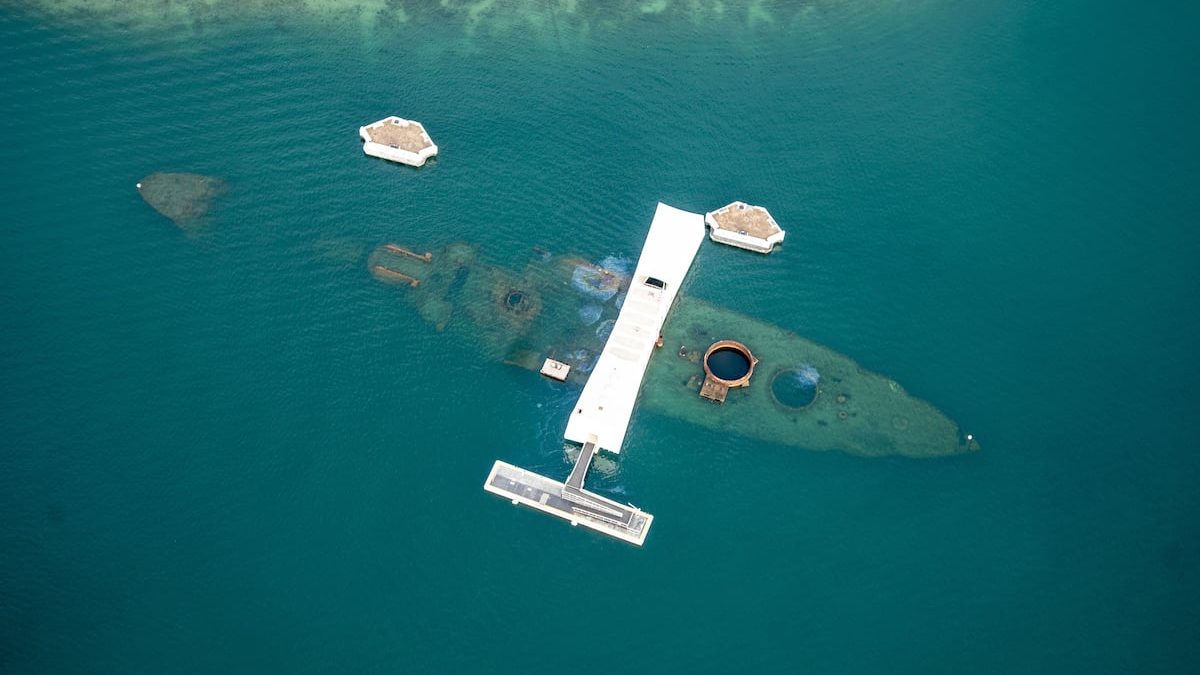
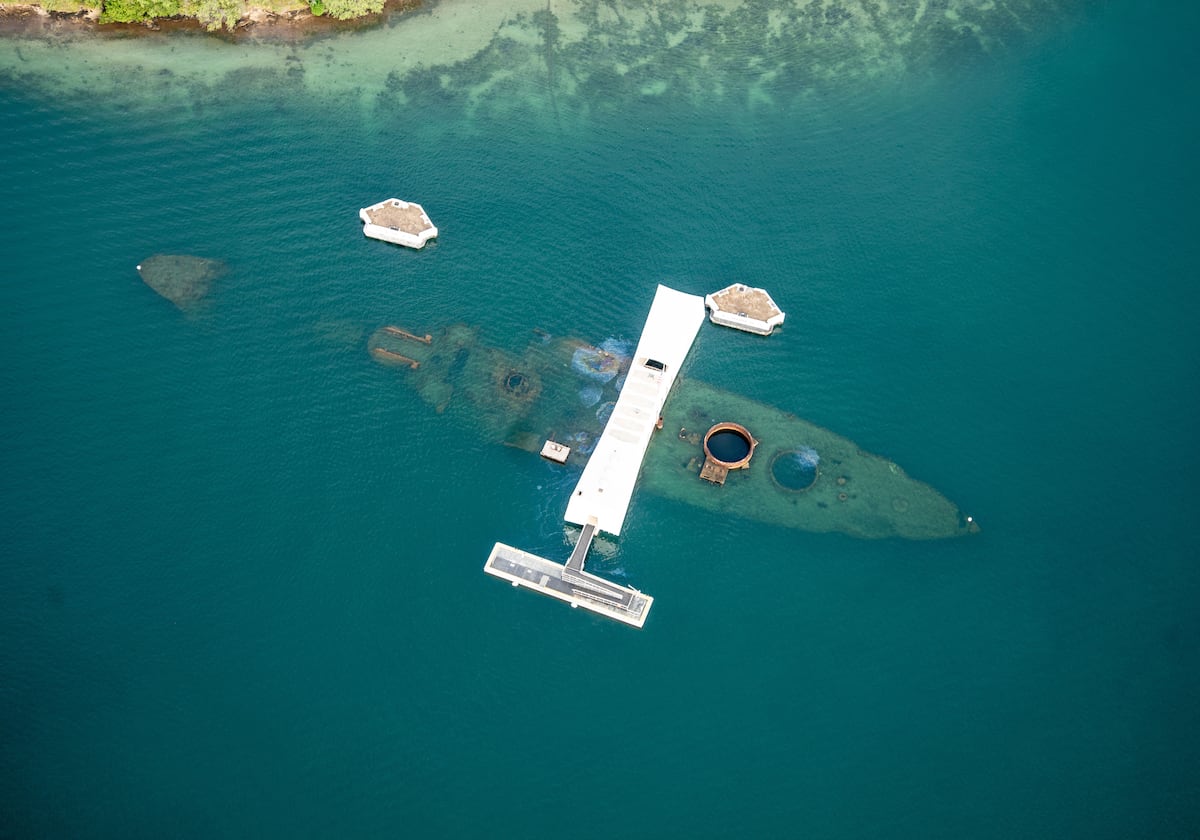
The hull of the 608-foot Pennsylvania class battleship Arizona now rests at the bottom of Pearl Harbor as the final resting place for more than 900 of the ship’s 1,177 crewmen who were killed on Dec. 7, 1941.
Above the hull, without ever touching it, is the gracefully stunning Arizona Memorial, officially known as the Pearl Harbor National Memorial, managed by the National Park Service.
The sloping roof of the memorial’s design, crafted by Austrian-American architect Alfred Preis, was intended to convey the profound symbolism of war and remembrance. The roof “sags in the center but stands strong and vigorous at the ends, expressing initial defeat and ultimate victory” in World War II, Preis said after the 1962 dedication of the memorial.
Read the full article here