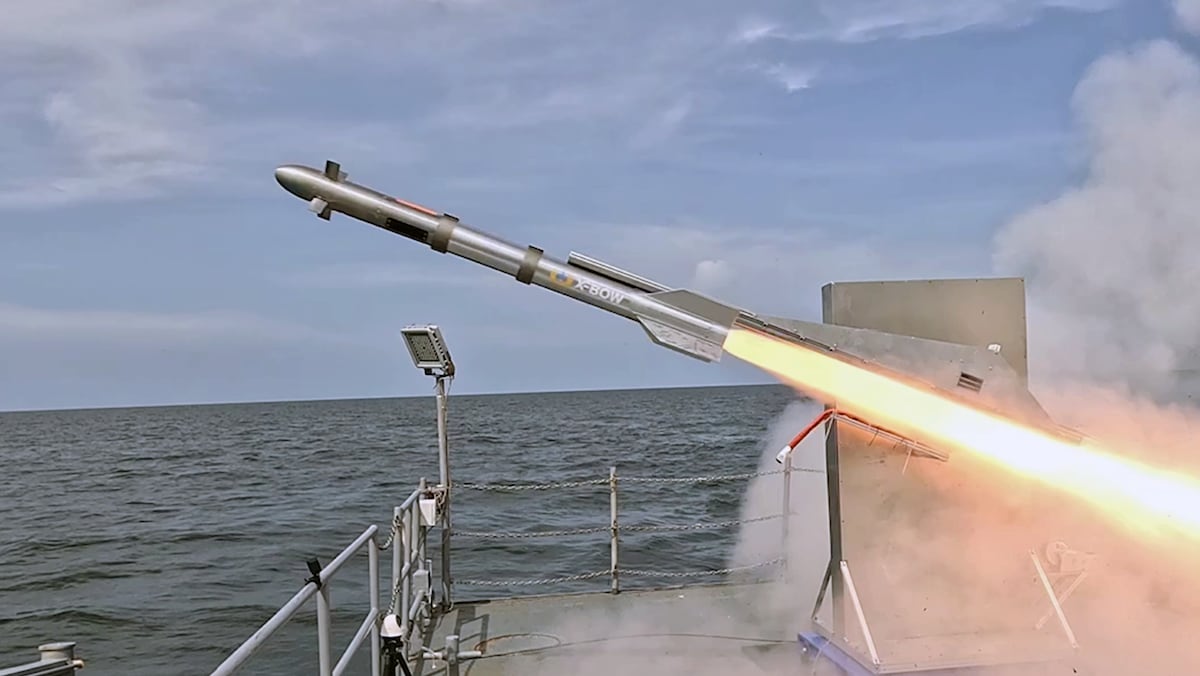

KYIV, Ukraine — The Department of Defense has awarded a contract worth almost $11 million to X-Bow Systems, a New Mexico-based rocket manufacturer, under a program aimed at developing a new anti-ballistic weapon for less than $750,000 a shot — roughly a fifth the cost of its top-tier equivalent, the Patriot missile.
First issued one year ago, the government’s original solicitation from the Missile Defense Agency’s Rapid Response Small Launcher Technology program called on tenders that could “rapidly demonstrate very low cost, modular interceptor designs to counter ballistic and hypersonic threats.”
Two companies, Northrop Grumman and L3Harris’ Aerojet Rocketdyne, have long held the domestic market for the solid rocket motors inside those weapons, while production of the Patriot itself runs through Lockheed Martin and Raytheon. Japan remains the only country ever licensed to build the missiles abroad.
“The contract will aim to address the critical need to expand the SRM industrial base, which is currently reliant on a duopoly of two primary manufacturers,” the DoD wrote in its contract announcement last month.
The program has taken on new urgency since the war with Iran left the U.S. with fewer than 1,000 Patriot interceptors and roughly 250 THAAD rounds, with each Patriot replacement costing roughly $3.9 million and taking years to build by a handful of licensed manufacturers facing almost no competition.
“America can’t out-produce today’s threats with yesterday’s supplier base,” X-Bow founder and CEO Jason Hundley said in a statement. “Our new manufacturing technology lets us bring affordable interceptors and rocket motors to the warfighter faster, and this award is a chance to prove it.”
X-Bow prints its solid rocket motors and propellant in-house and will use the phase 2 award, under MDA’s Low-Cost Interceptor effort, to fund further motor development and a first flight test.
“We’re taking a look at propulsion, we’re taking a look at all the expensive parts of an interceptor to look for opportunities to drive down every bit of cost in there as we move forward,” MDA’s Collins said earlier this month at the Space and Missile Defense Symposium in Huntsville, Alabama, per DefenseScoop.
Other parts of the government have also been trying to tackle the global interceptor shortage.
Last year, the U.S. Air Force solicited industry for a counter-air missile under $500,000 that it wants built by the thousands each year, according to Air and Space Forces Magazine.
Allied countries, still dependent on Patriot stocks to protect their own cities, have begun working toward antiballistic capabilities at lower price points, too.
Over the summer, Ukraine and European partners opened at least three new tracks toward cheaper ballistic defense, including the nine-nation Freyja initiative — a $700,000-a-round interceptor that Ukrainian strike-drone maker Fire Point says will be battlefield-ready next year — and Lockheed Martin’s new PAC-3 ACE missile, which the company says will be faster to produce and cost less than half as much as a PAC-3 MSE round.
Lockheed Martin and Raytheon have said little about providing Kyiv with the licensing necessary to begin manufacturing their own Patriot missiles, despite President Donald Trump’s July pledge to license the technology after years of withholding it.
None of the new options, American or Ukrainian-European, is expected before next year.
X-Bow’s agreement stipulates that the company must produce a prototype for the DoD for flight demonstration by late 2027 — not a battle-tested weapon — and the furthest-along Ukrainian alternative would reach the battlefield by mid-2027 at the earliest, according to manufacturers.
Katie Livingstone is the Ukraine correspondent for Defense News and Military Times. Based in Kyiv, she has covered Russia’s full-scale invasion since its first days. She is a former Fulbright fellow whose award-winning work has appeared in outlets across Europe and the U.S.
Read the full article here