
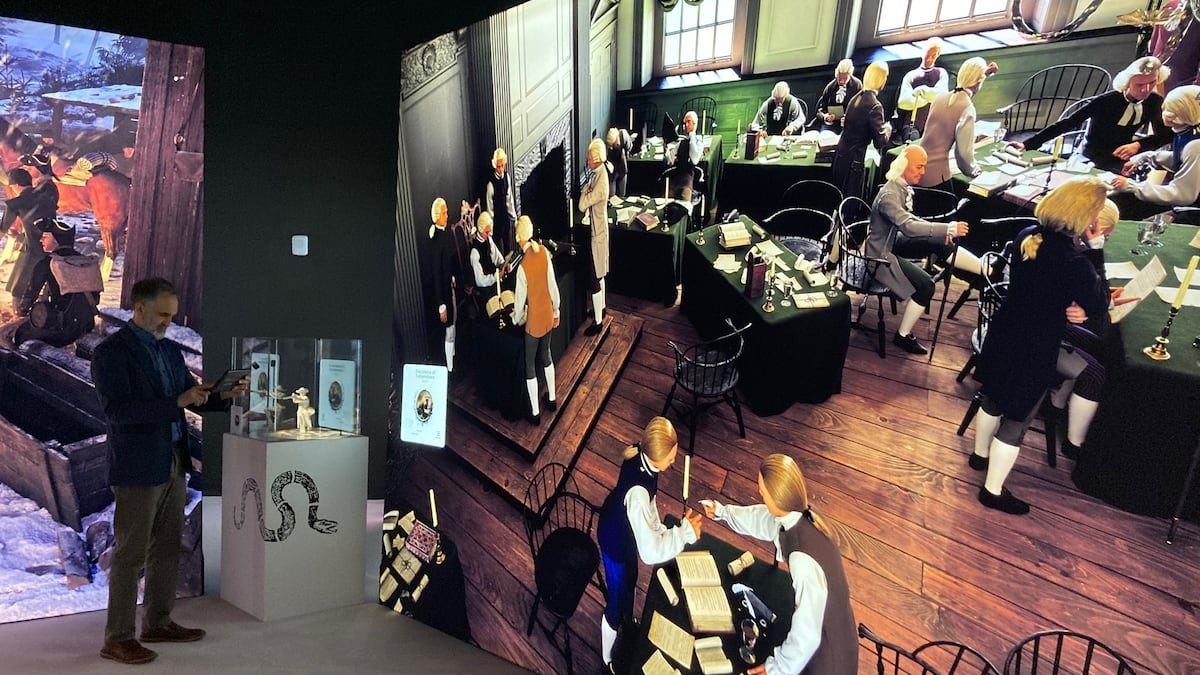

From the wildly popular traveling Van Gogh exhibit to the immersive “King Tut” experience that trades artifacts for hauntingly lit and realistic tableaux, museums everywhere are departing from conventional curated collections to find new ways to engage visitors. At the National Museum of the United States Army at Fort Belvoir, Virginia, staff hope a new augmented-reality exhibit featuring some 20 scenes from the Revolutionary War will create that fresh engagement while also building interest in the rare pieces of war history housed elsewhere in the building.
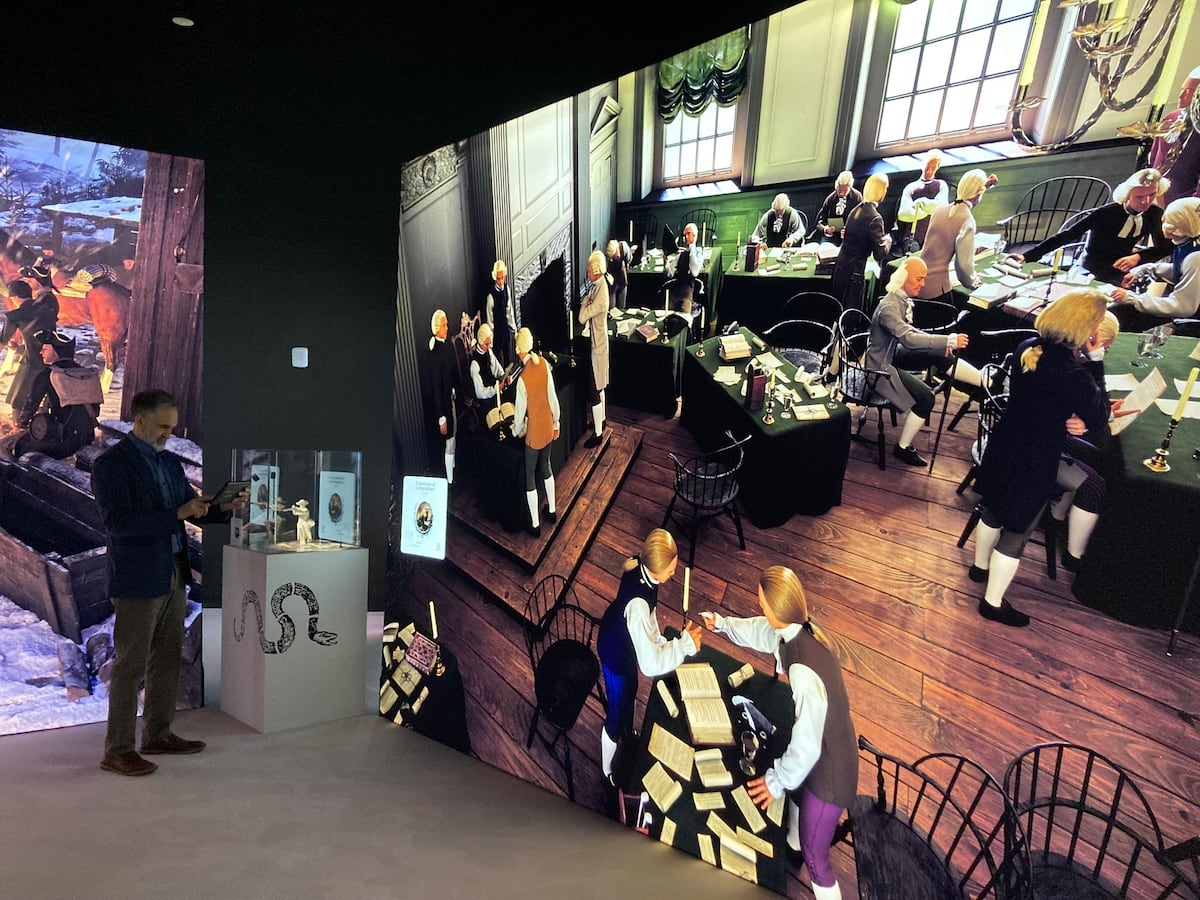
“American Revolution: The Augmented Exhibition,” which opens Saturday at the museum, uses the camera scanning feature of a museum-provided tablet to bring dramatically backlit displays to life. Scenes like the site of the Boston Massacre and Washington’s famous Delaware River crossing are mixed with video game-style period characters and allow visitors to pan the screen for 360-degree navigation of the space.
Selecting hot spots on the screen will bring you to the center of a crowd listening to a preacher fomenting revolution or transport you to Thomas Jefferson’s talking head, animated through generative AI.
Those seeking a “gamified” experience can select a treasure hunt activity through the various scenes, while those less keen on the immersive elements can take their tablets over to a comfortable corner in the exhibit space and manually swipe through all the scenes at their own pace, said Susan Smullen, a public affairs officer for the museum.
A particularly interesting feature for the larger interactive scenes lets viewers scroll forward in time to the same location in the present day.
In scenes like the Delaware crossing, mythologized in an iconic 1851 painting by Emanuel Leutze, the recreated scene and the present-day site comparison also serve to dispel misconceptions about what they moment was actually like.
“You’ll see… they’re actually sailing these, kind of, barges across,” said Matthew Eng, a communications and social media specialist at the museum. “And there is ice in the Delaware River as they’re crossing from Pennsylvania into New Jersey, but it’s not as dramatic as [the painting].”
The exhibit, created by French company Histovery as a touring exhibition, will be a centerpiece of the Army museum’s America 250 celebration. Last year, a new permanent exhibition, “Call to Arms” opened on the museum’s second floor, showcasing nearly 300 artifacts of the Revolution donated and on loan from other collections.
Highlights include the sword believed to be surrendered by Lord Cornwallis at Yorktown to end the war in 1781; and a pair of pistols and a pocket watch exchanged as gifts between George Washington and the Marquis de Lafayette.
Later this month, a replica of Washington’s field tent — sometimes called the first Oval Office — will open on the green outside the museum as another historical touchpoint.
Paul Morando, the first chief curator of the museum and newly installed director, told Military Times during a preview visit that the Revolutionary War was a particularly good fit for an exhibit that reimagined historical scenes, since it took place before photography and many stories about the soldiers who fought have been lost to history.
“Folks are learning not just about a particular battle; they’re learning about the people,” he said. “But it’s done from a heavily researched perspective, and not just as a fun experience.”
For the museum, which opened in 2020, it also represents a chance to generate fresh interest among both visitors and donors. Located 40 minutes away from Washington, D.C.’s world-class Smithsonian collections, the museum has sometimes struggled to attract its full capacity of visitors.
While the U.S. Army funds museum infrastructure and operations, the foundation contributes fundraising for programming and construction and manages revenue-generating functions like the gift shop. For donors, being able to sponsor individual “time portal” Revolutionary War scenes is exciting, said Jamie Hubans, vice president of Marketing and Communications at the Army Historical Foundation.
“A lot of those are individuals who have family connections to these stories,” such as an ancestor who served at Yorktown, she said.
The free exhibit replaces a paid simulator gallery that was seeing waning foot traffic, Hubans said. This augmented reality experience, which follows a smaller, but markedly successful, AR exhibit about D-Day, will also allow the museum to market itself anew to tour groups and other visitors.
Between the immersive exhibit and the artifacts collection, Morando stressed that soldier stories remain at the forefront.
“A lot of people forget we only declared our independence in 1776; it was up to our soldiers to fight and die for that independence. And I think sometimes that gets lost,” he said. “And these are just, most of them, common folks who decided to take up arms and do something extraordinary. They risked not only their lives, but their families, their way of life. … So that’s the message we’re trying to get across with an experience like this.”
“American Revolution: The Augmented Exhibition” will remain open until at least July 2027.
Read the full article here