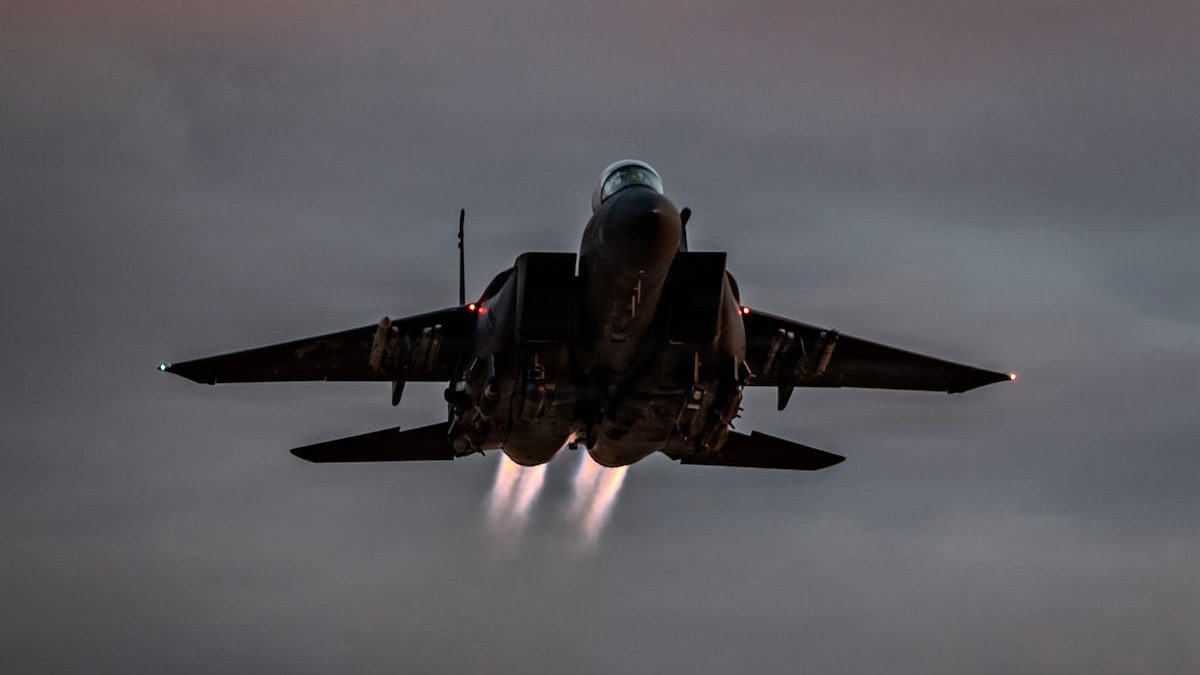
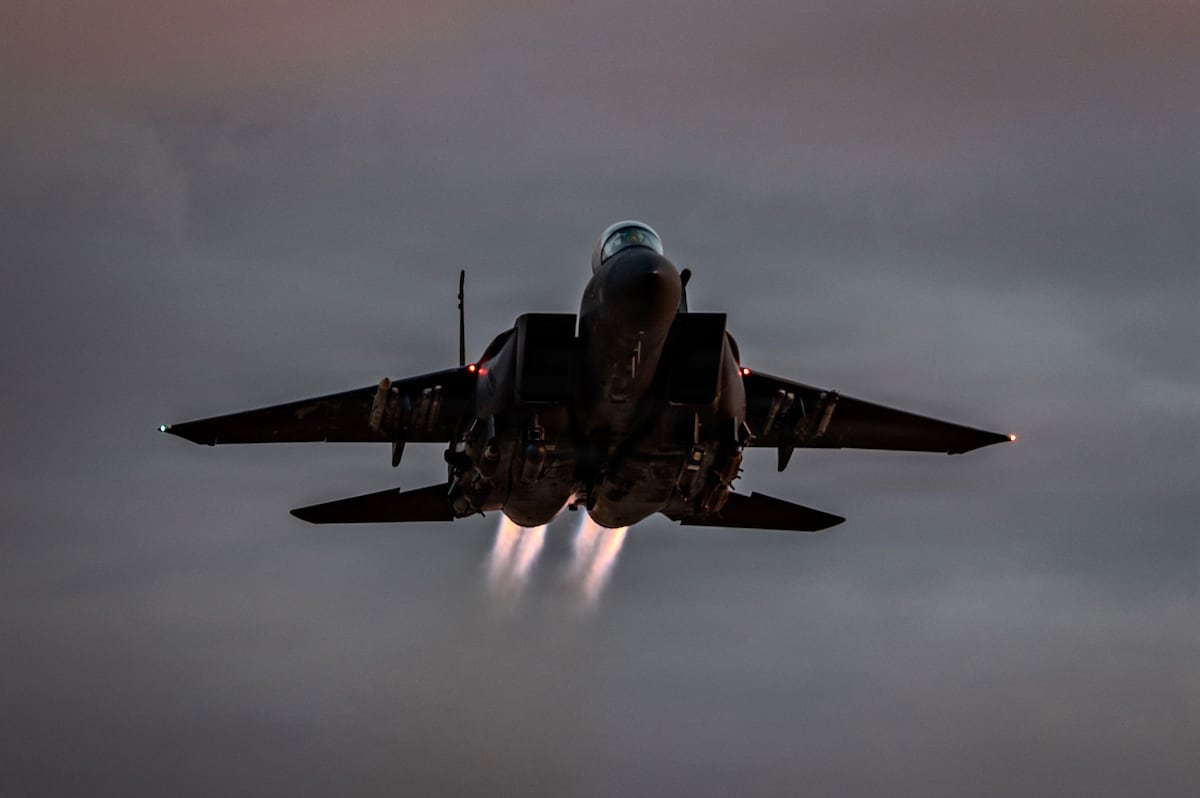
At 4:40 a.m. local time on Friday, a U.S. Air Force F-15E Strike Eagle, call sign Dude 44, was downed over southwestern Iran. Both crew members ejected, landing miles apart behind enemy lines. What followed was what President Donald Trump, speaking at a White House press conference on Monday, called “one of the largest, most complex, most harrowing combat search-and-rescue missions ever attempted by the military.”
The following is a chronological account of how events unfolded, based on U.S. Central Command statements, the White House press conference and reporting citing U.S. military and defense officials.
April 3: F-15E Strike Eagle shot down
The F-15E was conducting a combat strike mission over southwestern Iran as part of Operation Epic Fury when it was engaged by Iranian air defenses, according to U.S. Central Command. The shootdown occurred on the 34th day of the joint U.S.-Israeli air campaign against Iran, which began Feb. 28. At the time, U.S. forces had conducted more than 10,000 combat sorties over Iran and struck more than 13,000 targets, according to Trump.
The F-15E was the first manned U.S. aircraft confirmed lost to Iranian fire in the conflict, though several other aircraft had been damaged or destroyed in the preceding weeks by a combination of Iranian strikes and a friendly-fire incident involving Kuwaiti air defenses. The F-15E was brought down by a shoulder-fired, heat-seeking missile, according to Trump.
Both the pilot, call sign Dude 44 Alpha, and the weapons systems officer, or WSO, call sign Dude 44 Bravo, ejected safely, landing miles apart in hostile Iranian territory. The pilot came down in the Khuzestan Province area. The WSO evaded Iranian forces in the Zagros Mountains region of Kohgiluyeh and Boyer-Ahmad Province near Dehdasht.
Iranian state media released images of claimed wreckage, and Iran’s Islamic Revolutionary Guard Corps launched a manhunt, offering a reward of approximately $60,000 for information leading to the capture of the American crew, while appealing to locals for information.
One of the images appeared to show an aircraft’s vertical stabilizer, which displayed markings consistent with F-15Es assigned to the 494th Expeditionary Fighter Squadron of the 48th Fighter Wing at RAF Lakenheath in England, though CENTCOM declined to confirm.
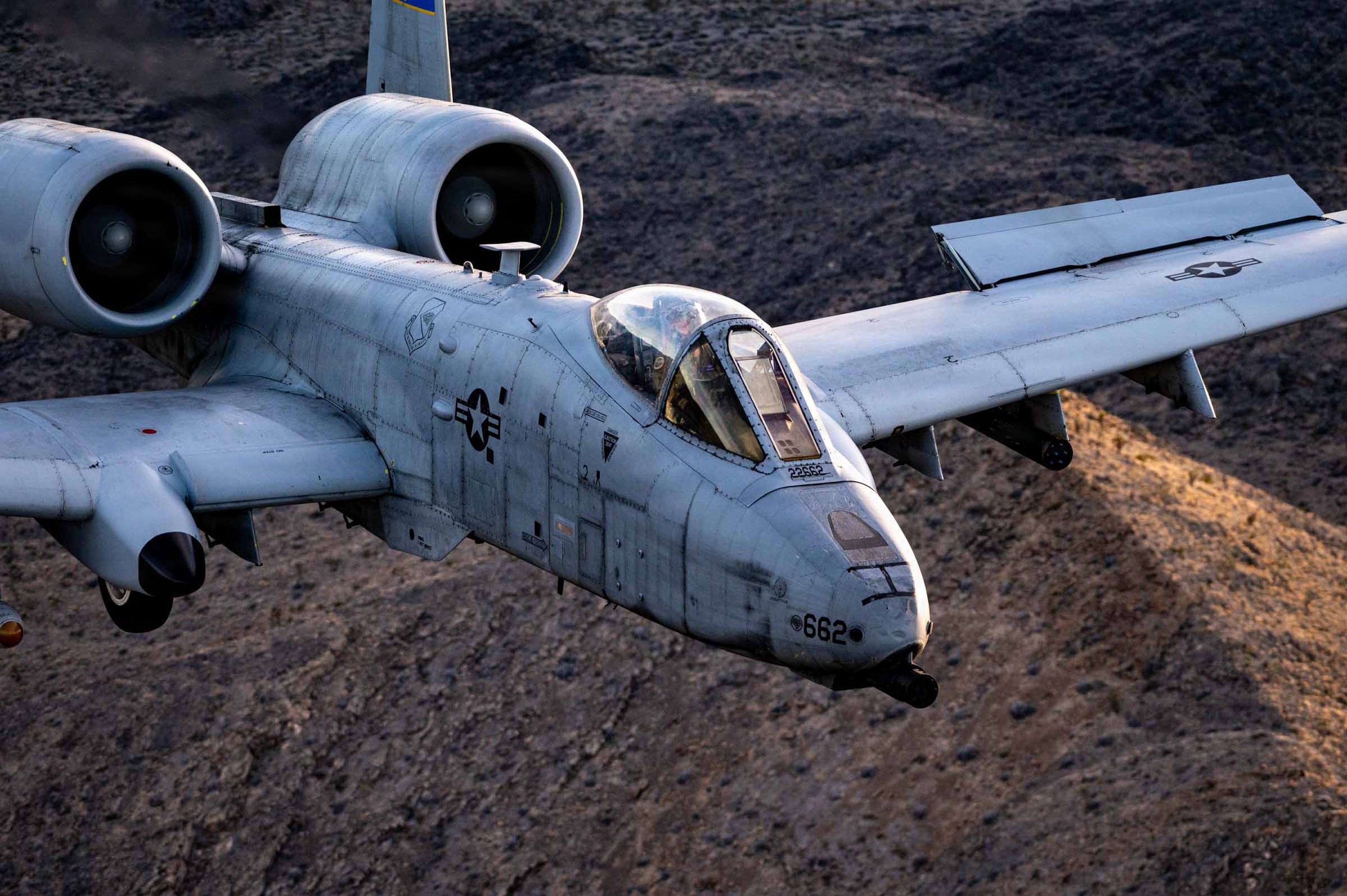
Chairman of the Joint Chiefs of Staff Gen. Dan Caine said at Monday’s press conference that a U.S. Air Force combat search-and-rescue task force was immediately assembled, comprising 10 A-10C Thunderbolt IIs in the Sandy role, HC-130J Combat King II aircraft, HH-60W Jolly Green II helicopters, and Air Force Special Warfare airmen, including combat rescue officers and pararescuemen. The package penetrated Iranian airspace protected by a fighter strike package, Caine said.
The pilot was located and recovered by U.S. forces within hours in a daylight operation that drew heavy ground fire. U.S. aircraft flew seven hours over Iranian territory to reach him. One of the two HH-60W Jolly Green II helicopters involved in the recovery took multiple hits from small-arms fire, wounding crew members aboard, Caine confirmed Monday. No U.S. personnel were killed.
Once the pilot was out of Iranian airspace, attention immediately turned to locating the WSO.
Meanwhile, one of the 10 A-10C Thunderbolt IIs providing Sandy escort for the pilot recovery mission took significant fire from Iranian forces. The pilot was able to fly the heavily damaged aircraft into Kuwaiti airspace before ejecting, as the aircraft crashed. The A-10 pilot was safely recovered, Caine said.
“A Sandy has one mission,” he said. “Get to the survivor, bring the rescue force forward and put themselves between that survivor on the ground and the enemy.”
Retired Air Force Col. Kim “KC” Campbell flew A-10s in combat over Iraq and is credited with successfully landing a severely battle-damaged Warthog under fire in 2003, earning her the Distinguished Flying Cross for heroism.
“Events this week have definitely brought back some memories from my experience in Iraq,” Campbell told Military Times. “I’m proud to be an A-10 pilot and I’m proud to be a Sandy pilot. What they have been able to do has truly been incredible.”
Campbell described the decision-making process a pilot faces after sustaining battle damage.
“The A-10 was designed to take hits while performing its mission,” she said. “The A-10 is durable, reliable and has multiple redundant systems. We train for battle damage so that when it happens we fall back on our training. Our redundant systems allow us to get back to friendly territory and eject or in some cases, safely land the airplane.”
The decision to land or eject is based on the aircraft’s condition, according to Campbell. “It’s a single-seat airplane so each pilot will make their own decision after assessing the damage, talking to their wingman and conducting a controllability check.”
The A-10 is uniquely suited for the Sandy role, Campbell said. In addition to going through a qualification program to become Sandy pilots, A-10 pilots routinely train for the mission, she said.
“A-10s possess unique hardware that assists in locating the survivor. Its slower airspeed also allows for more effective escort of rescue helicopters. Sandy 1, the rescue mission commander, typically makes a final assessment of the situation and makes the final decision to execute the pickup.”
For the aircrew who fly these missions, the U.S. military’s “leave no one behind” philosophy is more than a slogan.
“It’s absolutely critical,” Campbell said. “When we know that the cavalry is coming to get us to bring us home, it allows us to do our job and do it well. We understand the promise and the obligation that no one will be left behind.”
April 3–5: Locating and extracting the weapons systems officer
The WSO, described by Trump as “a highly respected colonel,” sustained significant injuries during ejection but remained mobile. While the F-15E pilot was being evacuated, the WSO was on the move.
Despite “bleeding profusely,” the WSO employed Survival, Evasion, Resistance and Escape, or SERE, tactics, traversing several kilometers across rugged mountain terrain, treating his own wounds and taking cover in a mountain crevice, according to Trump. Both crew members had activated their rescue beacons after ejecting, Caine said, aiding in determining their location.
The Wall Street Journal reported that MQ-9 Reaper drones flew overhead during the evasion period, firing on Iranian forces that closed in on the WSO’s position. Israeli officials confirmed that Israel provided intelligence support and postponed planned strikes on Iran to avoid interfering with the search-and-rescue effort.
As the WSO evaded, U.S. forces continued their search — a task CIA Director John Ratcliffe later described at Monday’s press conference as comparable to hunting for “a single grain of sand in the middle of a desert.”
Ratcliffe confirmed the agency executed a deception campaign and used “unique, exquisite capabilities” to locate the WSO concealed in a mountain crevice.
Trump described the scale of the aerial deception, saying U.S. forces deployed aircraft to seven different locations simultaneously to confuse Iranian search teams.
With the WSO’s location confirmed, Trump ordered an immediate rescue mission. The second rescue force launched overnight April 4–5 with 155 aircraft, including four bombers, 64 fighters, 48 refueling tankers and 13 rescue aircraft, supported by hundreds of special operations personnel across the operation, Trump said. U.S. forces flew seven hours over Iran in darkness to reach the WSO, he added, mirroring the seven-hour daylight operation that recovered the pilot two days earlier.
The ground extraction force included members of Naval Special Warfare Development Group, known as SEAL Team 6, according to The New York Times.
Among the assets deployed were three MH-6 Little Bird helicopters, transported inside MC-130J Commando II aircraft and reassembled by operators after offloading. “They rebuilt these helicopters in less than 10 minutes,” Trump said. “And that was one of the more amazing things.” Additional fixed-wing support included A-10s and MQ-9 Reapers for suppression and overwatch.
U.S. aircraft conducted sustained strikes on approaching IRGC elements, cratering roads and hitting Iranian convoys to keep them away from the recovery site. Caine described the force as fighting through “multiple simultaneous contingencies, something no other nation, no other military can do.”
Trump noted that not all of his military advisers supported the decision to launch the rescue. “There were military people, very professional, that preferred not doing it,” he said.
Self-denial and material costs
With the WSO recovered, the force began its extraction from the forward site approximately 14 miles north of Shahreza City in southern Isfahan province, according to open-source analysts.
Trump described the forward site as “a farm without a runway with wet, crummy soil, sand, mostly sand, wet sand, and it eats planes alive.” He noted that planners had anticipated the possibility that aircraft could become stuck and had replacement aircraft ready. When two MC-130J Commando II aircraft became stuck on the soft ground at the site, U.S. forces executed the preplanned contingency, and three additional aircraft were flown in to extract the force, Trump said.
The immobile aircraft were deliberately destroyed by U.S. forces to prevent sensitive technology from falling into Iranian hands. The destruction followed a well-established U.S. military protocol for self-denial of sensitive equipment, a doctrine that gained renewed attention after a modified stealth helicopter was destroyed during the 2011 raid that killed Osama bin Laden.
Trump described the decision: “We blew them up to smithereens because we had equipment on the planes that frankly we’d like to take, but I don’t think it was worthwhile spending another four hours there taking it off.”
The operation’s confirmed material losses included the original F-15E Strike Eagle, the A-10 that crashed in Kuwait and two MC-130J Commando II aircraft destroyed at the forward site. The War Zone identified imagery consistent with additional MH-6 Little Bird helicopters destroyed at the site, though the exact number remains unconfirmed.
Each MC-130J Commando II carries a unit cost of approximately $100 million, according to publicly available Air Force procurement data. Caine offered the guiding principle behind the self-denial decision: “People are more important than hardware. That is the standard we live by.”
Iranian reactions
Iranian officials disputed the U.S. characterization of the mission’s outcome. Khatam al-Anbiya spokesman Ebrahim Zolfaghari said the rescue operation “was completely foiled.” Iran’s parliamentary speaker Mohammad Baqer Qalibaf said: “If the United States gets three more victories like this it will be utterly ruined.”
Operational context
The CIA’s role in the mission, locating the WSO and running the deception campaign, represented a marked contrast with 1980’s Operation Eagle Claw, which also took place in Iran, where intelligence failures contributed to the mission’s collapse and the deaths of eight U.S. service members.
“The CIA was very responsible for finding this little speck,” Trump said. “A general was talking about it’s like finding a needle in a haystack, finding this pilot.”
Trump described the moment of confirmation: “40 miles away was the head of a human being. I’m telling you, it’s moving. And then all of a sudden, 45 minutes later, he moved a lot. Stood up and they said, ‘We have him.’”
The operation marked the first publicly acknowledged U.S. ground presence inside Iran since Eagle Claw in 1980, and the first successful combat personnel recovery from Iranian territory.
With the A-10 platform slated for retirement, its role as the Sandy in Iran raises questions about the future of the CSAR escort mission. Campbell said a capable replacement is critical.
“If the plan continues for the A-10 to retire … then it’s absolutely critical that we have a plan to fulfill both the CAS and CSAR roles,” she said. “Not just an aircraft assigned to it, but an aircraft that will routinely train for it.”
Both crew members remain in U.S. care. The Pentagon has withheld their identities, and neither has been identified by name in any official U.S. government statement.
Read the full article here