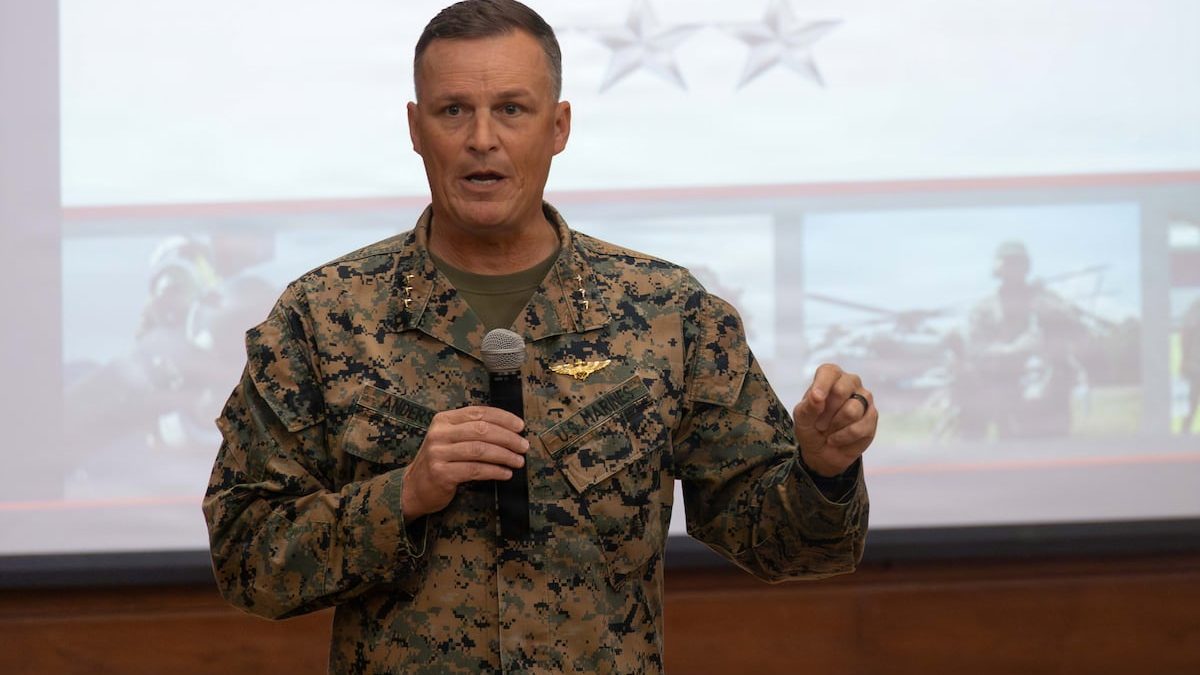

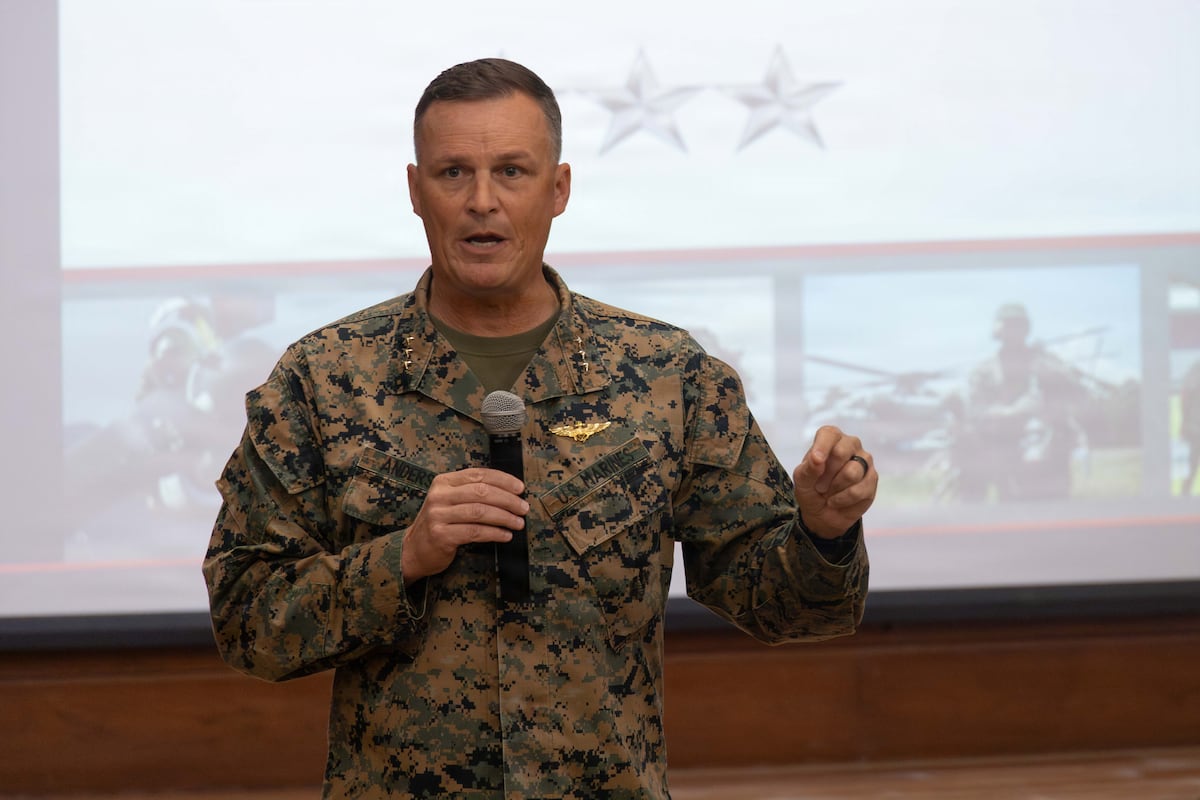
In a weekend address to his troops as news headlines trumpeted the possibility of upcoming combat deployments, the three-star head of Marine Corps Reserve command had a message: Get your cammies ready.
In a March 26 message on his official letterhead, Lt. Gen. Leonard F. Anderson IV asked his troops to consider whether they were ready for the possibility of being called up in the Iran war.
“I ask you directly: Are you truly ready to deploy, fight, and win? Are your skills sharp, your standards high, and your gear prepared for immediate movement?” he wrote. “Is your desert MARPAT readily available, is your gear packed and ready to pick up and move, or is it stored away in a corner of your home? Are your family’s affairs in order?”
These questions, he continued, were about readiness.
“When the call comes, readiness will be assumed, not questioned,” he wrote. “Your readiness is not a declaration; it is a daily commitment.”
The letter made a stir as it circulated on social media channels, with some posters speculating that it was a fake and others questioning its meaning.
“Sounds like a warning order,” one user wrote on LinkedIn.
In an exclusive interview with Military Times on Thursday, Anderson said he hadn’t become aware until a few days prior that his letter, which he confirmed authentic, was creating a stir.
His handwritten postscript — “Fight’s On!” — was, he said, the slogan of Marine Fighter Attack Squadron (VMFA) 312, his old squadron where he flew the F/A-18C Hornet.
“I just felt at a time on the planet and where we are as a force in the Marine Corps, it was just time for a reminder to the reserve force to be ready. And I wanted to get that message out as widely as possible,” he said. “I owe it to not only the Marines to make sure that they’re ready, but to their families, their parents, their wives, whatever it might be, if a reservist is activated and going forward.
“It’s my responsibility as the commander of Marine Forces Reserve to make sure that they are trained, equipped and prepared, and their families are prepared to put them forward. If I didn’t do that, if I wasn’t reminding the force to be ready, I’d be failing as a commander.”
Since the U.S. began strikes on Iran Feb. 28, the prospect of a longer fight involving ground troops has been the subject of intense speculation.
Defense Secretary Pete Hegseth refused to rule out a boots-on-the-ground scenario early in the assault, saying he did not want to limit military options. The Pentagon has reportedly begun planning for ground operations lasting weeks, and U.S. troops on ships and aircraft continue to pour into the region, at the ready for a major operation.
Anderson said the response he’s seen to his letter has been “overwhelmingly positive.”
“I have not … dived down into the long Reddit chains to dwell on some of the negative comments there,” he said, adding, “I don’t think there was a question out there from the majority of the reserve force that, yes, we should be ready.”
While most of the roughly 33,600 Marine reservists are typically in a drilling status, holding down civilian jobs while maintaining readiness in a contingency, recent conflicts have seen the rapid activation of Reserve forces.
Reserve forces responded immediately in the wake of the Sept. 11, 2001, terrorist attacks, and piloted the first fixed-wing aircraft into Afghan airspace, according to Air Force Reserve Command. Likewise, Reserve units were on the ground in the Middle East for months leading up to the 2003 invasion of Iraq.
Formally, full mobilization of the Reserves required a declaration of war or a national emergency by Congress. Partial mobilization of up to one million reservists for up to two years can be triggered by a presidential national emergency declaration.
An additional authority enables the president to call up 200,000 members of the Selected Reserve and up to 30,000 members of the Individual Ready Reserve — those who have recently left active duty — for up to a year.
The Iran conflict has also prompted speculation about the return to military conscription, a process that would require an act of Congress and, in ideal conditions, take the better part of a year to set in motion.
Anderson’s message emphasizes that readiness for drilling troops “is not a theoretical exercise.”
“Our forces are currently engaged in operations connected to Iran and are positioned to preserve stability in the Western Hemisphere,” he wrote. “Our enemies get a vote, and mass mobilization could become reality. We are operating in this environment now. History demands our readiness today, tomorrow, and every day.”
Anderson, who also commands Marine Forces South, is a career Hornet pilot and graduate of the Navy Fighter Weapons School, or TOPGUN, who served as a member of the Blue Angels demonstration team from 2002-2004.
He deployed twice to Iraq and Qatar in support of Operation Inherent Resolve, the coalition fight against ISIS. He has said the release of the original Top Gun film in 1986 influenced his decision to join the Marine Corps.
“Check your readiness,” Anderson wrote in the conclusion to his message. “Tighten your standards. Prepare your family.”
Read the full article here