
An Air Force veteran whose interest in international affairs was kindled by supporting the urgent U.S. withdrawal from Afghanistan in 2021 is now one of fewer than three dozen Americans to be named a Rhodes scholar for 2026.
Hadi Kamara, who separated from the Air Force in 2022 and is now a senior at Princeton University, highlighted his military work in his application for the Oxford, UK-based Rhodes Scholarship, which is awarded to about 100 students annually and boasts an acceptance rate of less than 5%.
Kamara, 25, had been a C-130 crew chief supporting the 86th Maintenance Squadron at Ramstein Air Base, in August 2021 when word came down that the Germany-based outpost would be receiving thousands of troops and Afghan nationals amid a hasty evacuation.
“I don’t think I appreciated just the scale of it,” Kamara told Military Times in a November interview. “Basically, we were clearing out the entire flight line [at Ramstein] to transform it into an empty space so we can start creating these long term stay tents, because we’re going to be the base that absorbs the vast majority of the evacuees from Afghanistan.”
For Kamara, the work, and witnessing the professionalism of service members to his right and left adapt to the situation and work to meet evacuees’ physical and medical needs, procuring food and flexing to other demands, regardless of job specialty, represented something of an inflection point.
Until that moment, his assignments had largely been domestic. But after supporting Operation Allies Refuge and the withdrawal, Kamara’s base became focused on another global crisis: Russia’s invasion of Ukraine and the war that ensued.
“As Americans, we can tend to be a bit insulated from the rest of the world, just given our distance you know — we’re surrounded by oceans on both sides,” he said. “But being in Europe, being in Germany at the time of these operations, really made this real for me, and seeing the effects that it had on human beings on the ground made it real for me. And so it became something that I became deeply intrigued by and wanted to learn more about.”
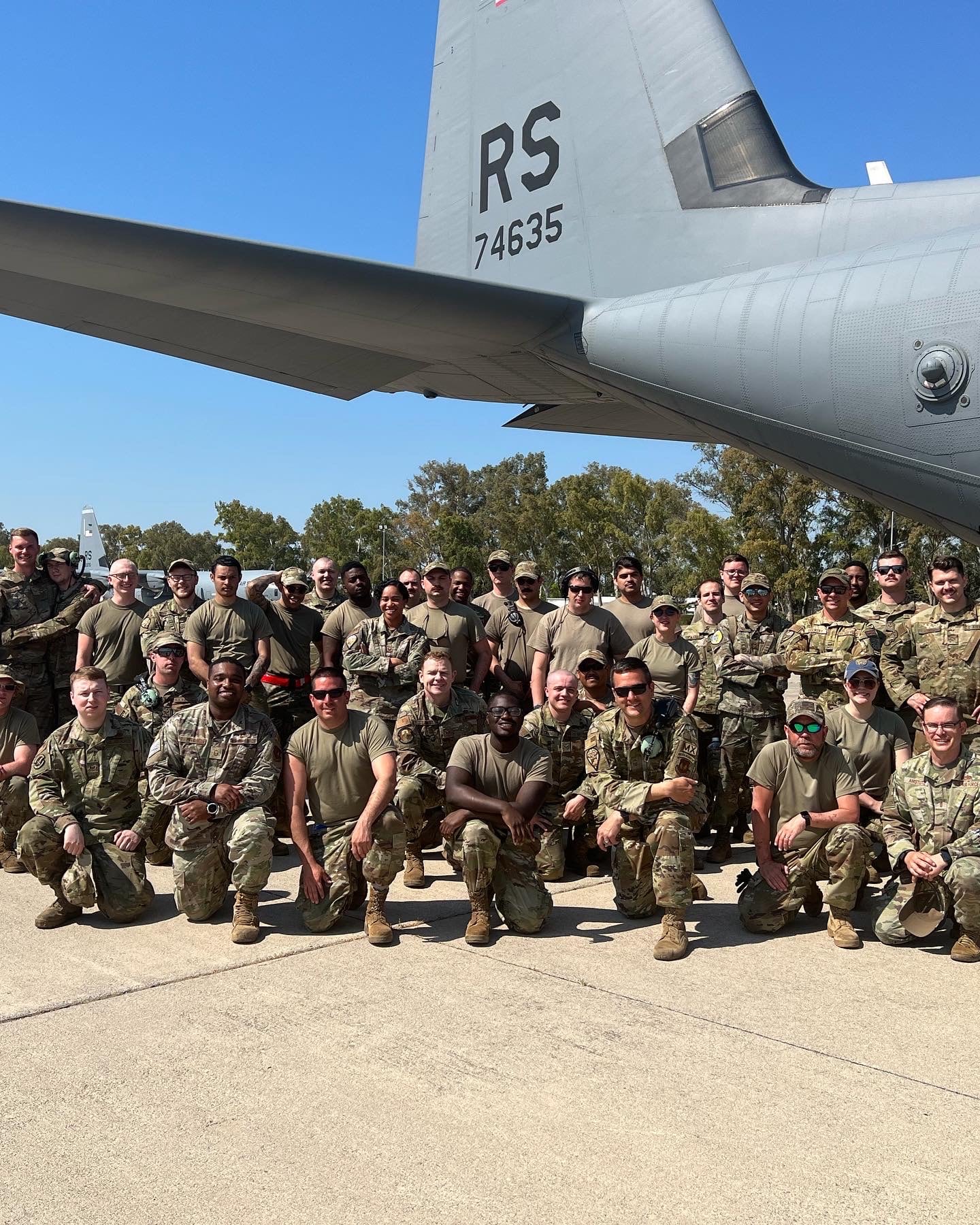
(Courtesy of Hadi Kamara)
As a high school student in Alexandria, Virginia, near Washington, D.C., Kamara had never pictured himself earning a globally coveted scholarship. A first-generation American whose mother came to the U.S. from Sierra Leone, Kamara was by his own admission an unimpressive student. But, he said, it wasn’t that he couldn’t do the work.
“I didn’t have discipline,” he said. “I just was not willing to dedicate my time, my energy and my focus to succeeding academically. But I was privileged in the sense that I always had a very robust network of people to support me.”
A turning point came for Kamara when he joined the Alexandria-based group The Untouchables, a mentorship organization with a presence at his high school, T.C. Williams. The school, made famous by the 2000 Denzel Washington blockbuster “Remember the Titans,” has since been renamed Alexandria City High. Mentors in the Untouchables helped focus his thinking about his future, resulting in the realization that the military would help him develop the discipline he sought.
“Call me biased, but I do believe that in the civilian world, the Air Force has probably the best reputation when it comes to specifically education,” Kamara said. “People joke, you know, [about] the ‘Chair Force,’ or the nerd branch, right? But — given that I was somebody who was really trying to better myself intellectually and academically — that reputation was actually something that I was drawn to.”
He opted for an aircraft maintenance specialist job pipeline out of a desire to gain exposure to work he hadn’t encountered before, including manual labor. He ended up with C-130 transport aircraft, another step that he believed would further his academic and career goals.
“Even before I joined the military, I always had a kind of inclination toward the international community,” Kamara said. “C-130s… we have locations everywhere, both domestically and internationally, and so being a C-130 crew chief also just gave me access to the most locations to be stationed.”
As Kamara wrapped up his final year in the Air Force at Ramstein, he turned his attention to education, first enrolling in Northern Virginia Community College and then transferring to Princeton. He “made a point” he said of making his experience at Princeton as focused on international relations as possible, making two trips to Kenya, learning Swahili and becoming immersed in East African politics. He also spent semesters abroad at the University of Sydney in Australia and at Oxford.
Princeton’s transfer program, he said, brought the prestigious Rhodes Scholarship to his attention, and by then, he had a clear vision for how he’d want to use it: to pursue a Master’s of Philosophy in international relations, focused on U.S.-Africa policy.
“Africa tends to be — it’s not a space of U.S. foreign policy that receives, in my opinion, adequate attention,” Kamara said. “You have in the region, on the continent, one of the youngest populations in the world… it’s going to end up making up a very large share of the world’s population. The African continent is very much at the heart of a lot of geopolitical incidents or engagements taking place right now.”
He cited the expansion of Russian influence on the continent and global competition for resources and questions about sustainability.
“There just don’t seem to be conversations that are taking place the way that I believe that they should, in U.S. academic spaces or in policy spaces,” he said. “And so if I can use some of my research to answer these questions and fill these gaps, I think it would be a good thing for me to do with my time as a student at Oxford.”
Kamara’s advice to other troops seeking a path after service was emphatic: Take advantage of the educational resources and benefits the military has to offer. Even for those who might not see a traditional college experience in their future, he said, tuition assistance can cover certification programs that will build a bridge to civilian work.
“I’d say my biggest thing that I’ve learned up to this point with my journey is that you never self-select, whether it’s in or out of the military,” Kamara added. “If there’s a promotion or a particular job that you’re looking at going for, go for it. If you’re thinking about transitioning out of the military, and you’re not too sure about whether or not you will succeed in the civilian world, plan adequately. I want to emphasize this: Plan adequately. But once you’ve made that plan, have faith in yourself.”
Read the full article here